Electro harmonix Electric mistress Deluxe vintage flanger and Sequential circuits Prophet 600.

Electro harmonix Electric mistress Deluxe vintage flanger and Sequential circuits Prophet 600.
Electro Harmonix Q-Tron and the Korg R3 in action.
The Q-Tron is the recreation of the Vintage Mu-TRON III , it’s an Envelope Follower with a multimode resonant filter , it’s an auto-wah.
The pedal reacts to the volume of the signal processed and control the sweep of the filter.
Today the interest is focused on ground-breaking technology or in knob laden keyboards, but what about the sound??
The Roland JD-800 was in the early ’90s the first synth with user interface full of sliders and buttons , in its way it is the predecessor of what came after it until todays…
the heart of the JD is a “sample & synthesis” generator, a 4 layer for patch synth with wave oscilators, multimode filters andextensive modulations and effects.
The JD800 was the D-50 done right!
Compared to the D-50 the jd lost the wave-synthesis (a sort of fm generator that emulates the analog generation of saw and square waves) but gained a lot of features , first of all the beautiful programming interface.
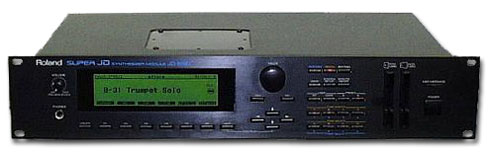
A year later Roland came out with their flagship JD in rack version, the JD-990!
The JD990 is based heavily on the JD-800 but has some intersting adds.
At first we could think that loosing the big programming interface will lead the JD990 to become the classic “sound-module” to be used with presets… but this is wrong!
The JD990 has in its way a wonderful and clear programming interface, a big LCD display that shows every parameter in a graphic way in order to make programming easy.
Together with the good display Roland addeed the ability to load expansion cards from the Roland JV serie, the SR-JV, that could improve the waveform palette, as type and number of waves but also with full quality.
The structure is the same of the JD-800: every Patch is composed of 4 layer, every layer has 1 wave generator, a multimode filter, 2 LFO, 3 ENV (1 for pitch, 1 for the filter and 1 for the AMP).
Every patch has the ability to configure the 4 layer in different chains/”structures”, in order to create more complex sounds and simple FM synthesis called FXM.
At the and of the patch chain we have a multieffects processor with modulation effects and ambient effects.
Speaking in terms of sounds , the JD-990 can produce a really vast range of sounds, from classic “analog- like” sound to complex evolving textures.
But the most important aspect is the “sound” itself.
The JD-990 is claimed to be the best sounding digital synth Roland produced till today.
It uses really hi-quality DAC , 44.1 KHz audio playback , against the 37KHz of the JV serie.
The really good audio converters and the warm sounding filters made this synth a classic!
With the ability to load SR-JV80 expansions the JD990 can be not just the box with its factory waves but can be expanded with many type of sound expansions from classic or acustic intruments to electronic o etchnic instruments.
As the JD is a master of pads and textured sounds , using the expansions can lead to interesting experimentation as layering strange asian sounds with electronic backgrounds.
The main carachter of the sound engine is however given by the “warm” dac , that tend to sound really “hi-fi” with a great definition on high frequencies and a tight but extended low-end.
Compared to the JV-1080 / 2080 the jd sounds smoother and rounder, while the jv is more edgy on high frequencies and more “loudness” but with less definition.
The result is a warmer and clearer sound.
exile from paradise / undertow by Samadhisound
A beautiful live recording taken from last year’s Punkt festival featuring a remarkable line up of musicians
jan bang – exile from paradise / undertow
(bang/ endresen/hassell)
jan bang: samples
lars danielsson: double bass
sidsel endresen: vocals
jon hassell: trumpet, keyboards
arve henriksen: trumpet
erik honoré: live sampling
recorded by geir østensjø at punkt, september, 2010.
mixed by erik honoré and jan bang at punkt studio kristiansand.
see also:
… and poppies from Kandahar (http://www.samadhisound.com/janbang/)
Released by: samadhisound
Release/catalogue number: sound-cd ss018
Trent Reznor last creation, the soundtrack for “Social Network” , is full of groundbreakin’ sounds.
Let’s hear what he says about his music and take a look at his studio in this interview.
Now synthvibrations.com has a facebook page too so you can follow our activities even from your FB account!
I’ve done some audio demo of the Harvestman Hertz Donut as a “standalone unit”, the audio path is just Hertz Donut and A132-3 VCA , no filters, no efx!
The only modules used to control the vco and the vca are a MFB ADSR on the VCA and a Plan B Model 10 on some sounds to control fm amount and wave discontinuity on the hertz donut.
The Hertz Donut is a voltage controlled digital dual oscillator that can provide sine, saw, tri and square waves on both the generators and a ringmod for the square waves.
The oscillators can work synched together in some different modes :
As you can imagine except for the No sync option the other sync options go from a classic perfect sync to a bad , worse or even “stupid” wich forces the second oscillator out of sync in random ways, shifting the sync point .
Harvestman Hertz Donut demo1 by francescopoggianti
The idea behind the Hertz Donut is to get a Zero-FM oscillator using a Primary (the first oscillator) and a MODULATION (second oscillator) with different kind of sync and modulation capabilities over Frequency , Wave Shape and AMP.
Frequency , Shape and AMP are the possible destinations of the modulation oscillator, the Hertz Donut is indeed a simple 2 operator FM & AM generator!
This is just a short demo of the Cwejman VCO2RM thru the STG Soundlabs “Post lawsuit ” LPF filter.
The VCO2RM is set on the middle wave (the modulated TRI) modulated by the VULCAN MODULATOR by Livewire.
Each VCO has its indipendent modulation rate.
The 2 vco are mixed by an A138 and then pass thru the STG LPF.
An A145 modulate (sine) the filter frequency.
The filter has 75% resonance and the frequency is between 5-6.